
Driver 01Weight 30%
Revenue Contribution
How your marketing channels are performing on the metric that matters most to ownership, revenue, relative to what peer hotels are generating from comparable investment.
The Marketing Efficiency Index evaluates the efficiency, balance, and resilience of your hotel's full marketing investment strategy, and benchmarks the result against peer properties with a single, explainable number.
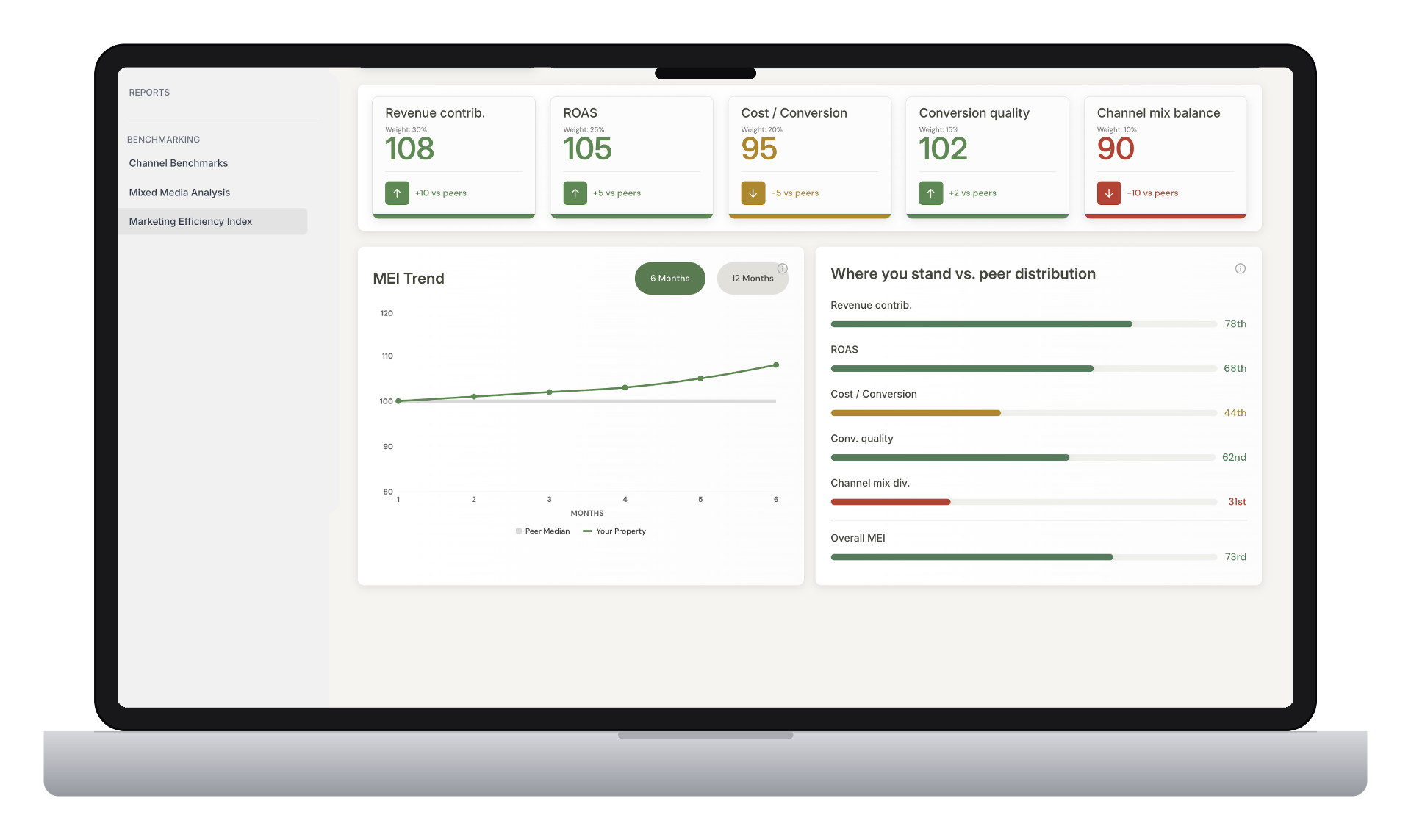
Every marketing platform generates metrics. ROAS, CPA, impression share, conversion rate, revenue contribution: the list goes on. Each one tells part of a story. None of them tells the whole story. And no individual metric tells you whether your overall marketing investment strategy is efficient, balanced, and competitive relative to the market.
That's the question ownership groups and management companies are increasingly asking. And it's the question most hotel marketing teams don't yet have a clear answer to.
The Marketing Efficiency Index is built to change that. One score. Every major efficiency driver. Full peer context.
Get started with Marketing Efficiency Index.
MEI combines the most important signals of marketing investment health into a single, weighted score, benchmarked against your peer cohort so the result always means something relative to the market.
How your marketing channels are performing on the metric that matters most to ownership, revenue, relative to what peer hotels are generating from comparable investment.
Return on ad spend benchmarked against your peer cohort. Not just whether your number is high, but whether it's competitive for a hotel operating in your market and segment.
Cost per conversion relative to the peer median. Identifies whether you're paying more than you should to acquire bookings, and which channels are dragging your overall cost efficiency.
Not all conversions are equal. This driver evaluates the quality and value of what your marketing is converting, not just the volume.
The structural resilience of your investment distribution. Heavy concentration in a single channel creates risk. This driver measures how balanced your portfolio actually is.
Scoring philosophy and contributing factors are transparent. Precise internal weighting formulas are proprietary.
MEI is indexed against your peer cohort, so 100 always represents the peer average for hotels like yours. A score above 100 means you're outperforming peers on overall marketing investment efficiency. A score below 100 points directly to where the structural gap is.
The score is not designed to replace individual channel metrics. It's designed to tell you where to investigate first, and give ownership a clear, credible headline about whether marketing is healthy before they ever open a dashboard.
Strong allocation efficiency, channel balance, and market-relative performance. Focus on sustaining what's working and monitoring for emerging concentration risk.
Performing at or above the peer average with specific opportunities to improve. Driver breakdown identifies where to focus.
Trailing peers on one or more key drivers. Actionable opportunities are surfaced directly in the score breakdown.
Structural issues in investment efficiency that warrant immediate attention. MEI identifies the specific drivers pulling the score down and surfaces priority opportunities.
MEI doesn't stop at a number. The full view includes everything needed to understand and act on your score.
Management companies and ownership groups are increasingly sophisticated about marketing accountability. They want to know whether marketing investment is healthy, not just whether individual campaigns performed.
MEI gives hotel marketers the single-number answer to that question, backed by peer benchmarks and a transparent methodology. It turns a complex, multi-channel marketing program into an executive-level headline, without sacrificing the detail needed to act on it.
The conversation MEI enables
"Our MEI score is 108, 8% above our peer average and trending upward over six months."
"Channel Mix Diversity is our lowest driver at 90, we're over-concentrated in Paid Search and we're addressing it."
"ROAS is our strongest driver at 112, we're protecting those channels while improving structural balance."
That's a different caliber of marketing conversation than most ownership groups are currently having.
RevPAR became the universal language for hotel revenue performance because it gave the industry a shared, normalized way to evaluate a complex outcome. MEI is designed to do the same for marketing investment efficiency.
The benchmark that powers MEI improves as more hotels contribute data. The peer average becomes more accurate. Cohort segmentation becomes more precise. The score becomes more meaningful.
The hotels participating in 2026 are the founding members of that standard, shaping what 100 means, what strong looks like, and what the industry will eventually measure itself against.
"MEI has the potential to become the standardized industry metric for hotel marketing investment efficiency."
MEI is benchmarked against real hospitality marketing data contributed by participating hotels. Every property that joins the network adds to the precision of the peer average, making the benchmark more accurate for every property type, market, and segment already in the system.
When you participate, you're not just accessing your score. You're contributing to the benchmark that gives your score meaning. That's a form of value that no standalone analytics product can replicate.
FAQ
Yes. The methodology is partially transparent: we explain the five contributing drivers, their relative weighting philosophy, and the peer normalization logic. The precise internal weighting formulas are proprietary.
Yes. Every MEI view includes a full driver breakdown showing how each of the five components contributed to your overall score, alongside a trend view and a prioritized opportunities panel.
That depends on your peer cohort. A score of 100 means you're performing at the peer average. Above 100 means you're outperforming peers on overall investment efficiency. The driver breakdown tells you what's working and what's dragging the score, regardless of the overall number.
MEI score and driver data refresh on a rolling basis as new performance data is processed. Cadence details are provided at onboarding.
The 2026 MVP operates at the individual property level. Portfolio rollups and cross-property MEI scoring are on the roadmap for future releases.
Individual channel metrics tell you how specific campaigns performed. MEI evaluates how efficiently your overall marketing investment is structured, across all channels, weighted by impact, and benchmarked against peer hotels. It's a fundamentally different level of analysis.
Hotel GMs, CMOs, and Revenue Managers use it for property-level clarity. Management company marketing leads use it for property-level accountability. Ownership groups and asset managers use it as an executive headline for marketing health.
MEI gives you the score. The driver breakdown tells you exactly what to do about it.